
Short answer. Letting by the night on Airbnb, Booking.com or Agoda brings in more than a twelve-month tenancy.
It also costs far more to run: 35% to 60% of gross revenue, where a lease costs you almost nothing.
So the two land closer together than the headline suggests.
What really differs is not the size of the number.
A lease pays the same amount every month, and puts all of it on one tenant.
Short stays pay a different amount every month, and put none of it on anyone.
That is the whole comparison in one table.
| A twelve-month lease | Short stays | |
|---|---|---|
| What arrives | The same amount, on the same day | A different amount every month |
| Gross figure | Lower | Usually higher |
| Cost base | Small. The tenant pays most running costs | 35% to 60% of gross, management 15% to 25% |
| Who owes you | One tenant, for a year | A few hundred guests, paid before arrival |
| If they default | Writ of Possession. 4 to 6 months uncontested, 8 to 12 or more if they fight it | A few empty nights |
| When you see damage | Once, at handover | Every turnover, which is every few nights |
| Using it yourself | Not for a year | Block any dates you like |
| Tax treatment | Section 4(d), no capital allowances | Section 4(a) business income, capital allowances allowed |
| Seasonality | None | Iskandar Puteri runs about 39% occupancy in December, 22% in April |
For years there was one answer to what you do with a Medini apartment you are not living in.
Find a tenant, sign twelve months, stop thinking about it.
Plenty of owners still do exactly that, and they are not wrong to.
But a lot of them here have quietly stopped, and the reasons they give are never about passive income or the future of travel.
They are small and specific.
A deposit that did not cover what the tenant left behind.
Four months waiting on a unit they could not get back.
Two things get said about short letting in Medini, usually by someone with an interest in you believing them.
That it earns more.
That it keeps the place in better shape.
Both are worth testing.
Both survive, in a smaller form than advertised, and the rest of this page is that test.
How a managed unit actually runs, what it costs and who does what, sits on the short-term rental page.
What changed on the demand side
Two things happened at once, pulling in opposite directions.
First, the visitors turned up.
Johor took more than 14 million foreign arrivals in the first part of 2025.
Between January and July, more than 11 million of those were Singaporean, which the state’s unity, culture and heritage committee chairman put at more than 78% of everyone who came.
Hotels felt it.
Johor Bahru occupancy ran at 61.4% from January to September 2025, up from 56.3% a year before, in Tourism Malaysia’s paid accommodation survey.
That is a jump of five points in a year, and it puts Johor Bahru fourth of the five busiest localities in the country.
And the biggest piece has not landed yet.
The RTS Link runs from Bukit Chagar to Woodlands North, built for 10,000 passengers an hour each way, with service targeted for the end of 2026 and full operations in January 2027, per MRT Corp.
A caveat, because this one gets oversold in every brochure in Johor.
That station sits in Johor Bahru city, about 25 km from Medini.
The RTS lifts how many people cross into Johor.
It does not turn Medini into a Woodlands commuter suburb.
Anyone telling you it does is selling.
The zone story has the same shape, and we set out what it does and does not do in is Medini part of the JS-SEZ.

What changed on the lease side
The second thing is that the long lease got harder, not easier.
At the end of 2025, Johor held 9,477 unsold serviced apartments.
That is the largest overhang of any state in Malaysia, on NAPIC’s own state table, ahead of Kuala Lumpur at 3,964.
We have gone through what that number does and does not mean separately.
Nine thousand empty units does something very specific to a landlord.
Your rent stops being set by what your unit is worth.
It gets set by whoever in your building is most desperate to fill theirs.
Across comparable Medini projects, gross yields sit in the 5.2% to 5.7% band and stay there, on rents of roughly RM2,000 to RM2,900 a month.
The reason is who the tenants are: students, hospital and teaching staff, young professionals starting out.
Nobody on that list is in a position to bid a rent up, and landlords here know it, which is why the competition runs on price and almost nothing else.
You cannot renovate your way past that.
Where there are too many flats, tenants pay for the address and for a clean unit.
A nicer sofa does not move the rent.
We put the same overhang figure in front of Singapore buyers, unburied, in a Singapore buyer’s guide to Bodaiju Medini.
Then there is the part nobody mentions until it happens
Malaysia has no Residential Tenancy Act in force.
Not a weak one.
None.
Your rights come from the tenancy agreement, the Contracts Act 1950, the Specific Relief Act 1950, and the ordinary civil courts.
So if a tenant stops paying and will not leave, there is no fast route.
The lawful route looks like this.
The court stage alone runs 4 to 6 months uncontested, and 8 to 12 or more if the tenant fights it.
- Day 0. The rent does not arrive. Nothing you can do yet has any legal force.
- Day 1 to 14. You serve a written cure notice stating what is owed and giving time to pay.
- Day 15 to 45. If it is still unpaid, you serve notice of termination under the agreement. Commonly 30 days.
- Month 2. They are still in the apartment. You file for a Writ of Possession in the Sessions Court.
- Month 6 to 14. Possession comes back. The earlier end of that is an uncontested file. The later end is a tenant who fights it. Throughout, you collect nothing and still pay the service charge, the quit rent and the loan.
Somewhere around month nine of that, the higher gross figure on a short-stay calendar stops sounding theoretical.
A Writ of Distress under the Distress Act 1951 is faster.
But read what it does: it recovers money, not possession.
It does not remove anyone.
Changing the locks or cutting the power is unlawful.
It turns your problem into a bigger one.
Which brings you to the part of short letting that nobody ever leads with, because it is not a number.
No single person can take a year off you.
The platform collects before arrival, the guest has a leaving date, and the worst any one booking can do to you is leave a few nights empty.
Does it actually earn more?
Half true, and the half that is false is the half people repeat.
The gross figure is usually higher.
The cost base is much higher too.
Short-stay running costs in Johor take 35% to 60% of gross revenue before any loan.
Management alone takes 15% to 25%, on Bamboo Routes’ July 2026 market figures.
Cleaning, linen, supplies, wifi, power, platform fees, insurance, and a furniture budget that never quite stays where you put it: all of it sits on your side of the line, where a lease would have quietly handed most of it to the tenant.
So the gap narrows once everything comes out.
In a weak year it closes.
There are published models where the one-year lease simply wins.
One widely cited Malaysian comparison puts a RM500,000 condo at 3.90% net on a lease against 1.63% net on a co-hosted short-stay, and concludes you need to hold above 65% occupancy to beat the lease.
We think that particular model is hard on short stays, because it charges every cleaning fee to the owner while leaving out the cleaning fee the platform collects from the guest.
Correct only that line and the gap moves a long way.
It does not close, though.
And a model that disagrees with us is worth more to you than three that agree.
We will not hand you an average that buries that, and we publish no occupancy or yield projection for Bodaiju at all, because the building is not finished and has nothing to project from.
What we can point at is real and nearby.
Over the twelve months to July 2026, the five Medini homes run by RoomGuru, the operator on our short-stay page, sold 78% of their available nights.
That is a full year, wet months included.
But it is five units and one operator, so treat it as the small sample it is.
The spread is worth more to you than the average, and it carries the half nobody advertises.
Across those five homes the guest ratings run from 4.82 to 4.98, so a unit lands somewhere in that band rather than on the headline number.
Wider than Medini, across all seventeen homes RoomGuru runs, fourteen of 1,177 Airbnb stays scored below four stars.
You do not have to take any of that from us.
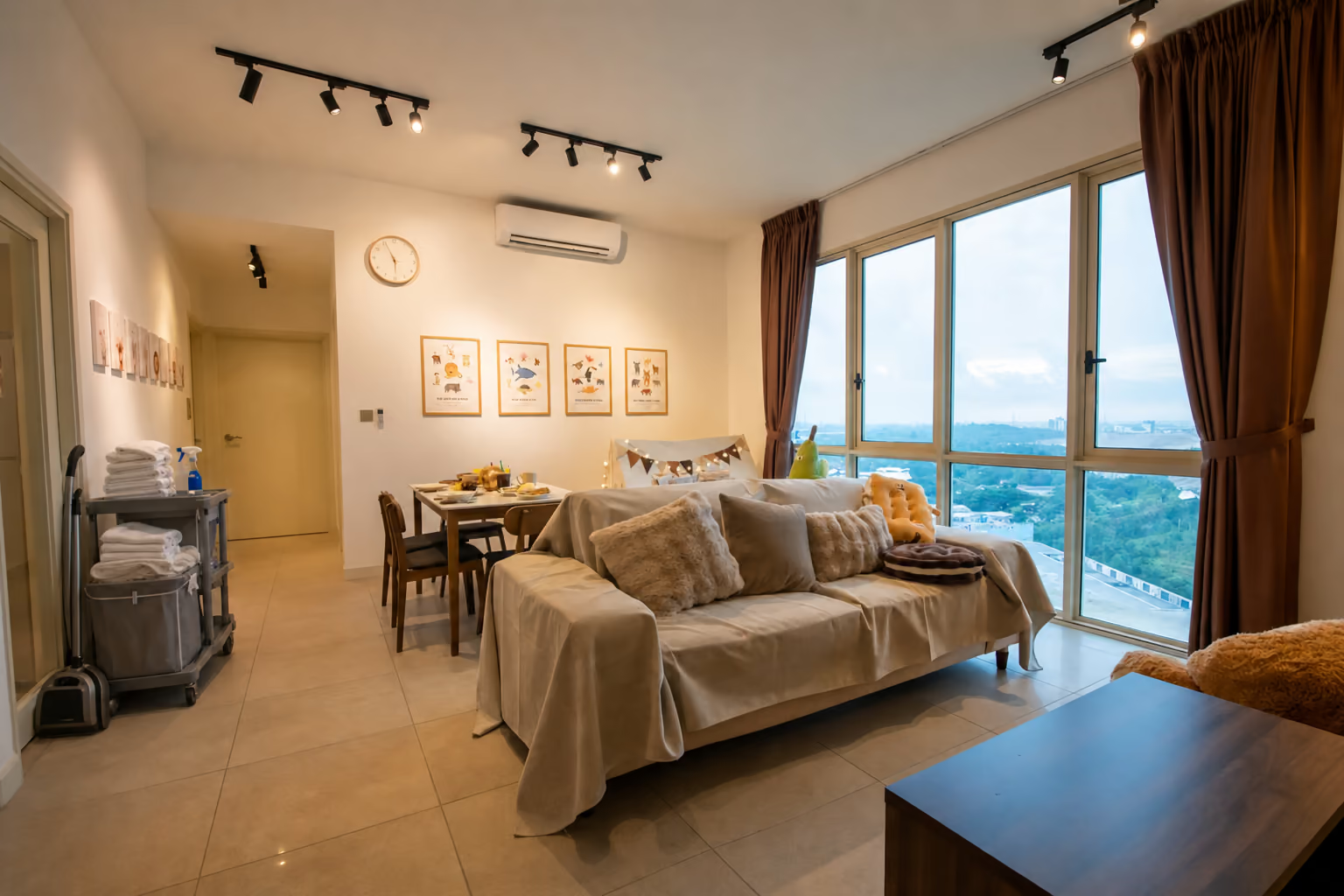
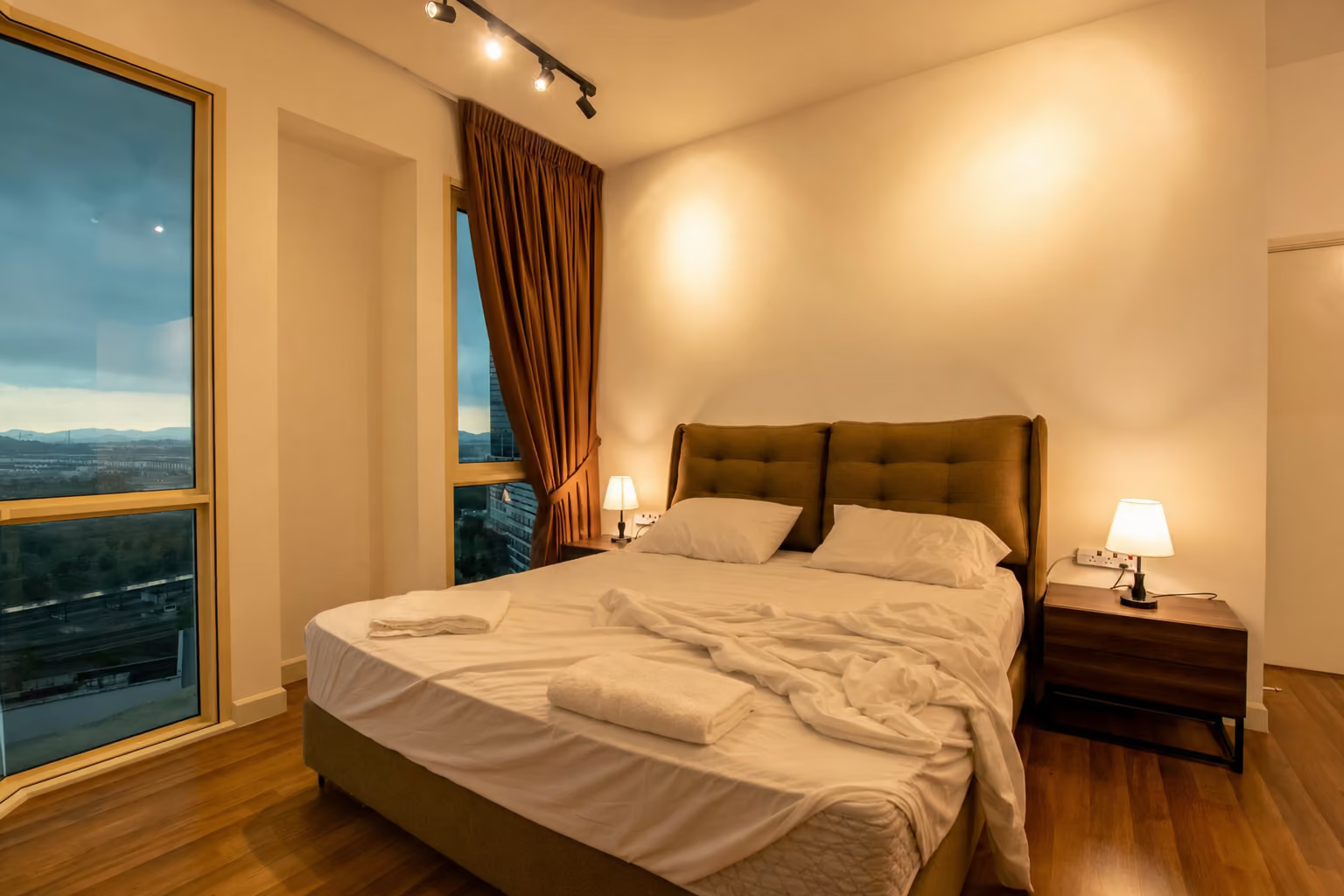
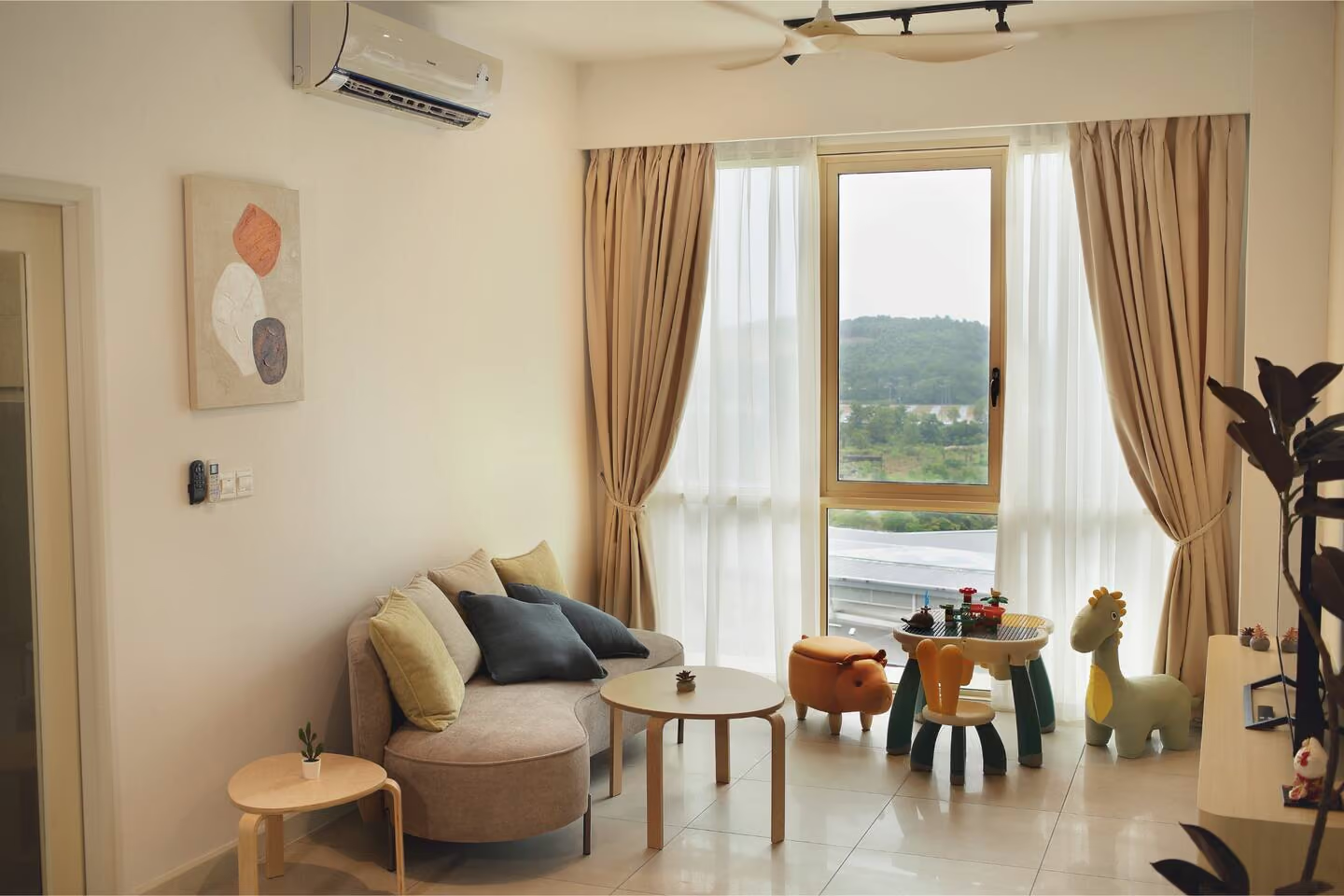
The apartment in the photographs on this page is AR 12-02, and its 132 Airbnb reviews are public, counted by Airbnb rather than by anyone selling you something.
Ask for those records.
Set them against what a twelve-month lease on your layout would fetch.
Then do the subtraction yourself.
Twelve months of occupancy and nightly rates on comparable Medini two-bedrooms, wet months and all. and we will send them, whichever way you end up going.
The tax difference nobody mentions
Under LHDN Public Ruling 12/2018, your income is taxed as business income under Section 4(a), not investment income under Section 4(d), once you provide active support services.
Nightly letting is exactly that.
The practical difference is that Section 4(a) allows capital allowances on furniture, appliances and qualifying fit-out, and Section 4(d) does not.
For a furnished unit that is not a rounding error.
Confirm your own position with a Malaysian tax adviser before you rely on it.
Does it really cause less wear and tear?
This one holds up better than the money claim, but not for the reason usually given.
A short-stay unit does not see less wear.
It sees more people.
The average stay across the Iskandar Puteri market is 3.7 nights, on AirROI’s data.
A unit that is actually being worked runs shorter than the market.
Over the twelve months to June 2026, the five Medini apartments RoomGuru manages averaged 2.4 nights a stay, and 40% of their bookings were a single night.
That is about 120 turnovers a year, so somebody is standing in the apartment looking at it roughly every third day.
What changes is when you find out.
Every one of those turnovers is a clean and an inspection.
A cracked hob, a leaking trap, a stained mattress, a failing aircon: all of it surfaces within days, gets attributed to a specific booking, and gets fixed while it is still small.
Under a twelve-month lease, you usually find out once, at handover, after the deposit was already fixed at two months’ rent.
Two months of rent, set against a year of quiet damage, is thin cover.
It is why deposit disputes are the most common fight between landlords and tenants in Malaysia.
So:
Short stays do not reduce wear.
They shorten the gap between something breaking and you knowing about it.
The furniture still ages.
It ages faster, in fact.
Budget for a refresh every few years and the claim holds up.
Skip that budget and it falls apart, along with the sofa.
It behaves like an investment, not a salary
This is where owners get caught.
A lease pays the same amount on the same day, and after a while you stop checking that it arrived.
Short stays pay a different amount every month.
In Iskandar Puteri, December runs at about 39% occupancy and April at about 22%, on AirROI’s July 2025 to June 2026 market data.
The calendar roughly halves between the best month and the worst.
RoomGuru’s own Medini calendars say the same thing from a different direction.
Over the twelve months to June 2026 those five apartments sold 93 nights between them in their weakest month and 169 in their strongest, a swing of 1.8 times.
The market data above swings 1.8 times too, and the two were measured by different people counting different things.
School holidays and long weekends carry the wet months, which is why the only unit of time that tells you anything here is a full year.
There will be quarters where the lease would have paid you more.
Not might.
Will.
If you need a steady figure to plan a loan around, sign the lease.
That is a real reason, and it is not the lesser choice.
If you can ride an uneven line for a better average, short stays are open to you.
That is a difference in temperament, and people keep mistaking it for a difference in skill.
Where short stays go wrong
Four things, and none of them are hypothetical.
Supply. Iskandar Puteri already carries close to 2,000 active short-stay listings.
Medini has a lot of new homes coming.
More keys chasing the same guests pushes nightly rates down, and nothing in last year’s records tells you when that starts.
Rules from the state. Johor has no state-level short-stay rules as at the first half of 2026.
National guidelines from the tourism and housing ministries are still waiting on Cabinet.
Selangor is the one to watch: a 180-night annual cap from 2026.
Note what that cap would actually do here.
180 nights is about 49% of the year, well above what most Iskandar Puteri units sell today.
So a cap of that shape would not bite.
A licensing regime would, and that is the real thing to watch.
The admin is yours. Bodaiju sits on a Service Apartment Title and is sold for short-stay letting, where an ordinary residential strata scheme often blocks it outright. The building’s own house rules arrive later, with the management body, so have the letting terms confirmed in your SPA.
The title part is settled. The rule book is the part to pin down in writing.
Running it is the part that is not automatic: house rules on access, noise and guest registration apply the same way they would to a long tenant, and local registration and the RM10 per night tourism tax on foreign guests are yours to handle.
We go through all of it with you at the gallery, where you can ask follow-up questions.
It is a business. Even fully managed, the furniture, the wear, the replacement cost and the paperwork stay with you.
None of this is set-and-forget.
How to actually decide
Two questions and one piece of arithmetic.
An hour, and you will know.
- Price the lease. Find what a twelve-month tenancy on your exact layout is asking in Medini today, from live listings rather than from anyone's opinion. Done when you have three comparable asking rents in front of you.
- Get twelve months of short-stay records. Real occupancy and real nightly rates from an operator, on two-bedrooms nearby, wet months included. Done when you can see the worst month, not just the average.
- Do the subtraction. Take 35% to 60% off the short-stay gross, then look at how each one arrives, month by month. Done when you know which of the two you could live with in February.
Here is that sum done once, on a two-bedroom.
Two inputs before the arithmetic, and we have taken the low end of both.
Medini and Legoland nightly rates run RM260 to RM420, so the sum uses RM280.
Medini long-term rents run about RM2,000 to RM2,900, so it uses RM2,200.
Pushing either one up flatters that side, which is why neither is pushed.
The short-stay side is a range rather than a number, and the reason is worth more than the arithmetic.
The two trackers do not agree on how full a Medini apartment runs.
AirROI puts Iskandar Puteri at 27.2% across the year to June 2026.
AirDNA puts Johor Bahru at 43%, which is a bigger and busier market than Medini, so read it as the optimistic end rather than the local one.
Look at where the lease lands.
It sits inside the short-stay range, not above it and not below it.
So the honest reading is that the occupancy assumption decides the answer, and nobody can hand you that number in advance.
On the local tracker the lease wins by about RM4,000.
On the wider-market one short stays win by about RM5,000.
Same apartment, same rent, same cost ratio.
That is not your number.
It is the method.
Anyone who shows you this comparison landing decisively on one side has picked the occupancy figure that gets them there.
We have just shown you both, which is why this block does not tell you what to do.
If the two land close, take the lease.
Less work, same money.
If short stays are clearly ahead and an uneven year does not bother you, the case makes itself and nobody needs to sell it to you.
Before any of it, understand what you are buying.
We cover that in how tenure at Bodaiju works.
We would rather you did the sums and said no, than took an average from us and said yes.